
269. How to Start American Accent Training
What app to choose?
We recommend starting with the American Accent App. With this app, you master pronunciation and articulation to achieve speech clarity.
Then move on to the Fluent American Speech and an accompanying video course, Get Rid of Your Accent Part Two, to master speech fluency, sentence stress and difficult speech patterns such as word endings and consonant clusters.
These two apps and two video courses are essential for accent reduction.
For those who want to master their presentation skills, we recommend 4Ps Power. Pitch, Pace, Pause app.
How to Start Training
Explore common pronunciation challenges for your nationality in the American Accent App
Begin with the video course to see how sounds are formed in the mouth. Use the mirror to check that your speech organs match those of the teacher in the video.
Follow up with practice using the apps
Focus on one lesson at a time and practice for 20–45 minutes per day
Continue for three consecutive days
Move on to the next lesson after three days
268. Which App to Choose?
Which App to Choose?
We recommend starting with Elocution Lessons and Get Rid of your Accent apps, and an accompanying video course, Get Rid of your Accent Part One. With these apps, you master pronunciation and articulation to achieve speech clarity.
Then move on to the Fluent English Speech app and an accompanying video course, Get Rid of your Accent Part Two, to master speech fluency, sentence stress and difficult speech patterns such as word endings and consonant clusters.
These three apps and two video courses are essential for accent reduction.
For those who want to master their Business English and presentation skills, we recommend Business English Speech and 4Ps Power. Pitch, Pace, Pause apps.
How to Start British Accent Training
Explore common pronunciation challenges for your nationality in the Elocution Lessons or Get Rid of your Accent apps
Begin with the video course to see how sounds are formed in the mouth. Use the mirror to check that your speech organs match those of the teacher in the video.
Follow up with practice using the apps
Focus on one lesson at a time and practice for 20–45 minutes per day
Continue for three consecutive days
Move on to the next lesson after three days
262. iOS Apps to Master English Speech
This article will help you choose the best apps to master Received Pronunciation, clear articulation, expressive voice modulation, and the strategic use of pauses. These core speaking skills are essential for public speakers and professionals who use English as a second language and want to sound confident, polished, and persuasive.
All the apps featured share powerful, user-friendly functionality. You can listen to expertly recorded audio by professional actors, record your own voice, and instantly compare your pronunciation with the model, making progress measurable and motivating.
British English:
Elocution Lessons. This app is ideal for children and people who have just started learning English. This app has 48 lessons. It contains short, commonly used phrases, sentences and verses that are easy to repeat, and it also has useful tips for teachers of English. It is actually useful for everyone as it contains essential, everyday English.
Get Rid of your Accent. This app is ideal if you want to get rid of a regional or foreign accent and to speak with Standard English or RP (Received Pronunciation). It has 42 lessons; it contains effective practical exercises to perfect all English sounds and perfect your articulation.
Fluent English Speech. This app is a follow-up to the Get Rid of your Accent app. It is ideal if you want to develop fluency in English and sound more like a native English speaker. It contains exercises for difficult and connected speech patterns, natural flow of speech, intonation, sentence stress and onomatopoeia.
Business English Speech. This app was designed for top-level professionals, diplomats and lawyers. It is the only app on the market that has both English pronunciation and business vocabulary training. It contains 43 lessons with material gathered from interviews with CEOs, CFOs and MDs of global companies and helps to develop proficiency in English.
4Ps, Power, Pitch, Pace, Pause. This app is ideal if you want to get rid of monotonous speech and become a successful presenter and public speaker. It contains practical exercises for voice modulation and the use of pauses.
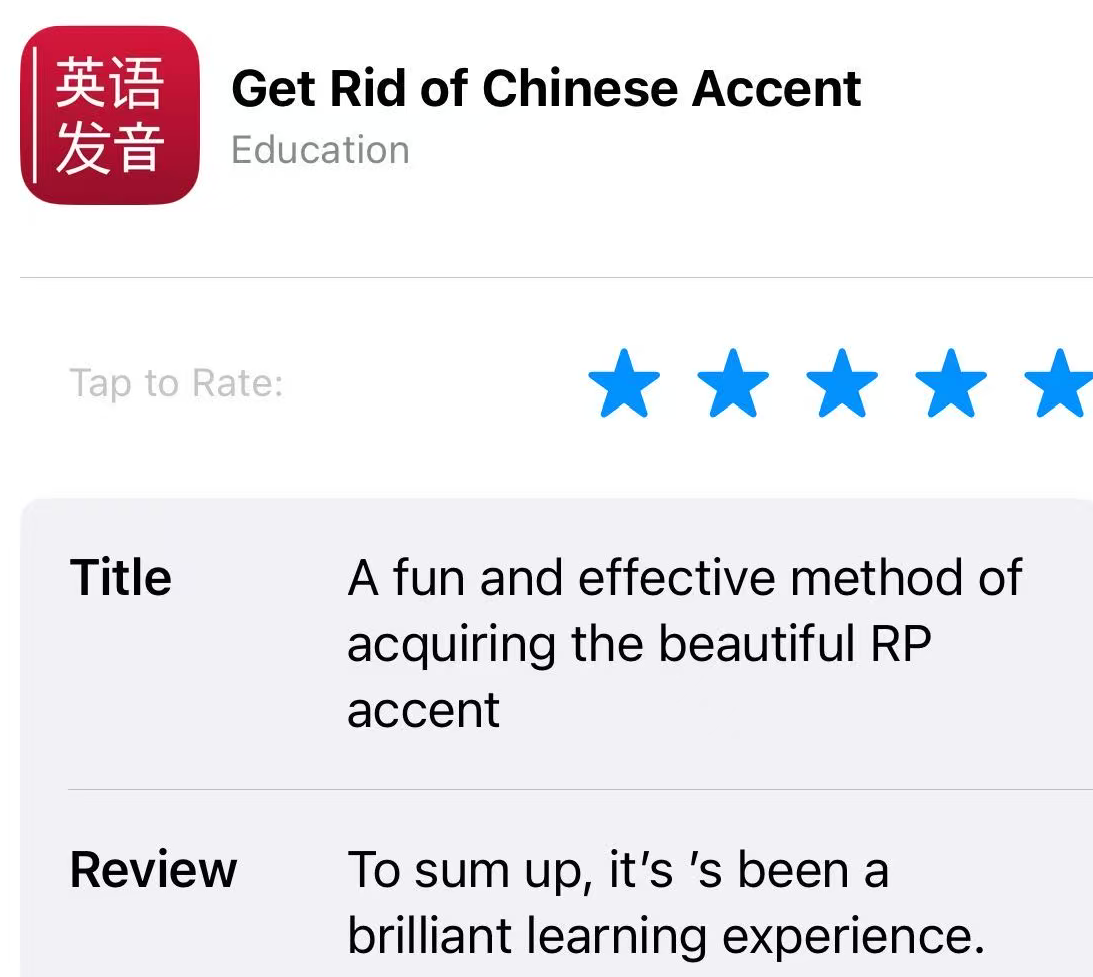
Get rid of Chinese Accent. This app is the same as the app Get Rid of your Accent, with an additional bonus - Chinese translations.
Get Rid of Russian Accent. This app is the same as the app Get Rid of your Accent, with an additional bonus - Russian translations.
General American English:
American Accent App. This app is ideal if you want to get rid of a foreign or regional accent and master the Standard American accent. It has 42 lessons. It contains effective, practical exercises to perfect all American English sounds.
Fluent American Speech. This app is a follow-up to the American Accent App. It is ideal to develop fluency in your American English speech. It contains exercises for difficult and connected speech patterns, natural flow of speech, intonation and sentence stress
More on www.batcsglobal.com
251. Did You Know “O” Can Be Pronounced Five Different Ways?
In many languages, words are pronounced in the same way they are spelt.
In English, spelling and pronunciation are not identical. English has inherited many foreign words, including those from Latin, French, Dutch, and German, and it has anglicised the pronunciation while retaining the original spelling.
In this article, I will give examples from our elocution apps of how one letter “o” represents several sounds:
In words, “come, oven, front, company” it represents the / ʌ/ sound as in “duck” (Lesson 9)
In words, “those, phone, no ” it is pronounced as a diphthong /əʊ/ as in “blow” (Lesson 16)
In words, “corner, storage, form”, it is pronounced as a long /ɔː/ sound (Lesson 3)
In words, “stop, office, box”, it is a short /ɒ/ sound (Lesson 10)
In unstressed syllables, it is pronounced as schwa /ə/, as in “the”. I highlighted the schwa: “confirm, London, potatoes” (Lesson 6)
You noticed that I mentioned lesson numbers from our elocution apps in brackets. This is to help you practise these sounds.
British English
American English
When using the apps, avoid looking at the spelling the first time you practise a sound. This helps you overcome confusion caused by English spelling and focus purely on pronunciation. Listen carefully and repeat the sound in words, phrases, and verses.
There are no fixed rules for when a particular sound is used. However, by working with our elocution apps, you’ll start to notice pronunciation patterns and have plenty of opportunities to practise them.
Subscribe to our newsletter and visit www.batcsglobal.com to receive daily pronunciation tips.
Warmly
Olga Smith
249. One Letter Pronounced in Five Sounds
In many languages, words are pronounced in the same way they are spelt.
In English, spelling and pronunciation are not identical. English has inherited many foreign words, including those from Latin, French, Dutch, and German, and it has anglicised the pronunciation while retaining the original spelling.
In this article, I will give examples from our elocution apps of how one letter “o” represents several sounds:
In words, “come, oven, front, company” it represents the / ʌ/ sound as in “duck” (Lesson 9)
In words, “those, phone, no ” it is pronounced as a diphthong /əʊ/ as in “blow” (Lesson 16)
In words, “corner, storage, form” it is pronounced as a long /ɔː/ sound (Lesson 3)
In words, “stop, office, box” it is a short /ɒ/ sound (Lesson 10)
In unstressed syllables, it is pronounced as schwa /ə/, as in “the”. I highlighted the schwa: “confirm, London, potatoes” (Lesson 6)
You noticed that I mentioned lesson numbers from our elocution apps in brackets. This is to help you practise these sounds.
British English
American English
When using the apps, avoid looking at the spelling the first time you practise a sound. This helps you overcome confusion caused by English spelling and focus purely on pronunciation. Listen carefully and repeat the sound in words, phrases, and verses.
There are no fixed rules for when a particular sound is used. However, by working with our elocution apps, you’ll start to notice pronunciation patterns and have plenty of opportunities to practise them.
Subscribe to our newsletter and visit www.batcsglobal.com to receive daily pronunciation tips.
248. Your Personal Language Style
We all have our own personal style — a voice shaped by the environment we grew up in. The words we choose, the rhythm of our sentences, even the phrases we repeat without thinking - they all carry traces of our background, experiences, and the people who’ve influenced us.
Maybe you picked up a calm, measured tone from a parent who spoke thoughtfully. Or perhaps your speech has the warmth and colour of a lively neighbourhood where stories were traded like treasures. Over time, these influences blend into a style that’s uniquely yours - your linguistic fingerprint.
What’s fascinating is that our style continues to evolve. New environments, social circles, and technologies reshape how we speak and write. The way you text a friend today might be miles apart from how you wrote letters ten years ago — and that’s perfectly natural. Language is alive, and so are we.
Our personal style isn’t just about grammar or vocabulary; it’s about identity. It tells the world who we are, where we’ve been, and how we see things. Recognising and refining your style doesn’t mean losing authenticity - it means understanding your voice and using it with purpose.
So as you read this week’s edition, take a moment to reflect:
What’s your style saying about you?
We offer a personalised speech analysis designed to help you discover and refine your unique communication style.
Through this in-depth analysis, you will:
Gain a clear understanding of your personal language style
Identify your strengths and areas for growth
Receive detailed, actionable recommendations to enhance your speech and voice
To book your session, email oriana_r@hotmail.com or text +447971246806
Warmly
Olga Smith
www.batcsglobal.com
244. How Long Does It Take to Get Rid of an Accent?
This is one of the most common questions we hear from people starting our elocution lessons.
The answer depends on two main factors:
1. Your ear for language – how well you can hear and imitate sounds.
2. Your commitment – whether you can dedicate 15–45 minutes a day to focused practice.
People with a naturally good ear often make faster progress. However, the second factor is far more important. Accent reduction is not just about listening — it’s about retraining your speech organs (your tongue, lips, and jaw) to produce the correct English sounds consistently.
Like any physical skill, it takes regular, mindful practice. The more you train, the faster your muscles and mind adapt — and the sooner you’ll sound clear, confident, and natural.
You can start your practice today with our apps:
Get Rid of your Accent (British English, RP)
American Accent App (American English)
Warmly
Olga Smith
235. The Power of Three
Have you noticed how often the power of three shows up in our daily lives? A good meal consists of a starter, a main course, and a dessert. A good day includes work, rest, and play.
Take my belly dancing class today. It felt amazing because it had:
1️⃣ A nice warm-up
2️⃣ A well-paced rehearsal of our routine for the upcoming show
3️⃣ A wonderfully relaxing stretch to finish
The same principle applies to public speaking. A strong speech always has:
1️⃣ An engaging introduction
2️⃣ An interesting main part
3️⃣ A memorable conclusion
And yes, even in elocution lessons, the pattern holds true:
1️⃣ Warm-up muscular exercises
2️⃣ Practising a sound or speech pattern
3️⃣ A fun verse or rhyme exercise at the end
Why does this work? Because our brains love structure. Three feels complete, balanced, and easy to remember. If you’d like to apply the power of three to your own speech and communication, you can explore my apps:
Now, I’d love to hear from you. What’s an example of the power of three in your own life? Share it in the comments—I can’t wait to read your ideas
232. Overcoming the Fear of Speaking English in Public
Speaking English in public can feel intimidating, even for people who have studied the language for years. The fear of making mistakes, being misunderstood, or sounding “different” is common—but the good news is that it can be managed and overcome with the right mindset and practical techniques.
Why We Fear Public Speaking in English
There are several reasons why speaking English in front of others can feel scary:
1. Fear of Mistakes
Worrying about mispronunciation or grammar errors can make you hesitant to speak at all.
2. Lack of Confidence
Not being sure about your vocabulary or fluency can make public speaking stressful.
3. High Expectations
Many people compare themselves to native speakers and feel pressure to “sound perfect.”
Understanding the cause of your fear is the first step to addressing it.
Practical Steps to Build Confidence
Here are some strategies that can help you speak more confidently in English, whether in meetings, presentations, or social situations:
1. Start Small
Practice speaking English in low-pressure situations—like ordering a meal, speaking with friends, or reading out loud at home. Small wins help build confidence gradually.
2. Focus on Clarity, Not Perfection
Instead of worrying about sounding like a native speaker, aim to be clear and understandable. Your audience values clarity more than perfect pronunciation.
3. Use Pauses Effectively
Pausing after each idea gives you time to think and reduces nervousness. Practising Power, Pitch, Pace, Pause (4Ps) can make your speech more natural and easier to follow.
4. Record and Listen to Yourself
Recording your voice and listening back allows you to notice your strengths and areas for improvement. Apps like Get Rid of Your Accent or Fluent English Speech provide guided exercises for intonation, articulation, and fluency, making this process easier.
5. Practice Public Speaking Gradually
Start with a small audience, then gradually increase the number of listeners. Toastmasters, online language meetups, or even speaking to family members can help you practice in a supportive environment.
Mindset Matters
Remember, everyone makes mistakes, even native speakers. Mistakes are part of the learning process and do not define your ability to communicate effectively. Celebrate your uniqnes and your progress, no matter how small, and be patient with yourself.
Final Thought
Overcoming the fear of speaking English in public takes practice, patience, and perseverance. Start small, focus on clarity, and gradually challenge yourself. With consistent effort, you’ll progress and feel proud of your progress.
Useful Tip
Incorporate a few minutes of daily practice with guided exercises from apps like Get Rid of Your Accent or Fluent English Speech—you’ll be amazed at how quickly your confidence grows.
More on www.batcsglobal.com
231. Get Rid of Russian Accent
This app is designed especially for Russian speakers who want to reduce their accent and speak clear, confident English. Based on the bestselling series Get Rid of Your Accent, it combines proven elocution lessons with step-by-step practice. All speech organ positions are translated into Russian, making it easy for learners to master English sounds and correct pronunciation quickly.
Why It Works
Trusted by actors, diplomats, teachers, and business professionals, this accent app helps you:
Understand how each English sound is formed with Russian explanations
Practise pronunciation, articulation and intonation
Master all sounds of Received Pronunciation (RP) – also called Queen’s English, Oxford English, or BBC English
Improve fluency for public speaking and everyday conversation
App Content
48 lessons with words, phrases, short sentences, verses, and articulation drills, tongue twisters, rhythmic exercises, and passages
Audio recordings of native English speakers for accurate English pronunciation
Functionality
Listen & Repeat– copy pronunciation, liaisons, and intonation
Record & Compare – hear your voice and track your progress
With regular practice, you will:
• Neutralise your Russian accent within 1–3 months
• Speak English that is clear and easy to understand
• Gain confidence for teaching, studying, or working internationally
• Sound professional and fluent in English communication
Meet the Authors
Linda James (RAM, Dip. Ed., IPD, LRAM), Speech and Drama coach, trained at the Royal Academy of Music, with 20+ years of experience teaching RP and accent reduction in London drama schools, films, and TV.
Olga Smith (BA Linguistics, MBA), Linguist, public speaker, and co-author of the best-selling *Get Rid of Your Accent book series. Having overcome her own strong Russian accent, Olga brings practical expertise to learners worldwide.
Visit www.batcsglobal.com to book a professional speech analysis.
229. American Accent App
American Accent App uses a proven drama school speech training method to help you speak clear, confident English. Trusted by actors, lawyers, diplomats, and professionals worldwide, it will help you neutralise your accent and master General American English pronunciation.
Content
Start with clear diagrams and explanations of how each sound is formed
Practise with words, sentences, verses, and articulation drills
FunctionalityListen & Repeat – Hear model pronunciation for every sound.
Record & Compare – Match your voice against native RP speakers.
CD Function
With this app, you will:
✅ Neutralise your accent within 1–3 months
✅ Make your English clear, confident, and easy to understand
✅ Improve communication and public speaking skills
✅ Boost confidence and professional image
✅ Enhance career opportunities worldwide
228. Fluent American Speech App
Based on the international bestseller Get Rid of Your Accent Part One and Two, General American Accent Training Manual, ISBN 9780955330087, this app helps you reduce your accent, perfect your American English pronunciation, and speak fluently with confidence.
With practical elocution lessons and vocal techniques, Fluent American Speech explains the rules of difficult American speech patterns, intonation, and sentence stress. Step by step, you’ll learn how to neutralise your accent and achieve a clear, natural speaking style.
App Content
Contractions for natural fluency
Liaisons for smooth connections between words
Strong and weak forms for authentic speech
Intonation and sentence stress for clarity and impact
Difficult word endings & silent letters with guided practice
Functionality
1. Native model audio tracks
2. Listen & repeat training
3. Record your voice
4. Compare pronunciation instantly
What You’ll Gain:
1. A fluent American accent in just 1–3 months of practice
2. Confidence in social and professional English speech as well as in public speaking
3. Improved job prospects, education, and social interactions
4. A professional voice that sounds natural, clear, and persuasive
Whether you want to get rid of your accent, prepare for public speaking, or simply improve your fluency in English, this accent app works like a personal coach in your pocket.
Start your journey to perfect American English pronunciation and fluency today and watch your career and social life blossom!
227. Online Accent Reduction Course for Professionals
Start with a proven system designed to help you communicate clearly and confidently in business settings.
⭐Step 1: Practise professional English vocabulary with a clear British accent
Get Rid of your Accent Part One (Video Course)
👉 Develop clear pronunciation and good articulation of business terms
🚀Step 2: Sound more natural and fluent
Fluent English Speech (App)
Get Rid of your Accent Part Two (Video Course)
👉 Improve intonation, sentence stress and fluency - sound more like a native speaker
Why This Course?
The most complete resource for Business English speech training; includes 43 lessons built on real business language
Written in the style of the Financial Times and The Economist
Covers finance, IT, law, HR, and marketing vocabulary
Used by professionals worldwide to advance their careers
Many of our clients have been promoted after improving their speech clarity and business communication with this app and lessons
The Method of Learning
Begin with the video course to see how sounds are formed in the mouth
Follow up with practice using our app
Focus on one lesson at a time
Practice for 10–45 minutes per day
Continue for three consecutive days
Move on to the next lesson after three days
Key Features
🪞👄Watch the video for and copy the speech organ positions with the mirror
🎧 Listen & Repeat – Hear model pronunciation for every sound
🎤 Record & Compare – Match your voice against native speakers
💿 CD Function – Optional audio practice
225. Fluent English Speech App
The follow-up to the bestselling Get Rid of Your Accent UK1 app. Designed for learners who want to speak English fluently, clearly, and confidently—just like a native speaker.
App Contents
Part 1: Master difficult speech patterns — word endings, consonant clusters, schwa, strong & weak forms.
Part 2: Connected speech — learn to speak in natural phrases instead of separate words.
Part 3: Improve intonation, sentence stress & rhythm — make your speech smooth, clear, and engaging.
Functionality
1. Native model audio tracks
2. Listen & repeat training
3. Record your voice
4. Compare pronunciation instantly
With this app, you will:
Develop English fluency and natural flow
Improve pronunciation, intonation & rhythm
Learn idioms & colloquial expressions to sound authentic
Reduce your foreign accent and speak with confidence
Boost career opportunities and personal impact through clear communication
Meet the Authors
Linda James (RAM, Dip. Ed., IPD, LRAM), Speech and Drama coach, trained at the Royal Academy of Music, with 20+ years of experience teaching RP and accent reduction in London drama schools, films, and TV.
Olga Smith (BA Linguistics, MBA), Linguist, public speaker, and co-author of the best-selling *Get Rid of Your Accent book series. Having overcome her own strong Russian accent, Olga brings practical expertise to learners worldwide.
Visit www.batcsglobal.com to book a professional speech analysis.
223. How Chinese Can Become Even More Successful
I have many Chinese friends and colleagues. What I have noticed about them all is how hard-working and goal-oriented they are. There is also one thing almost all of them had in common: they struggled with English pronunciation.
The 6 biggest challenges for Chinese speakers of English:
1. Final consonants (e.g., pound, sound, found)
2. /t, d/ endings in past tense (learned, hoped)
3. /l/ vs. /r/ sounds (London vs. rat)
4. Fricatives /θ/, /ð/, /f/, /v/ (think, that, fake, victory)
5. Diphthongs like /au/ (cow, pound)
6. Intonation, connected speech, and sentence stress
Our Recommendations
Start with consonants, then move to vowels and diphthongs.
Practise using our apps: Elocution Lessons, Get Rid of Chinese Accent, and Business English Speech (available on App Store & Google Play).
Combine with the video course, Get Rid of Chinese Accent
Once sounds are clear, focus on intonation and fluency using the video course Get Rid of your Accent Part Two and the app Fluent English Speech app.
My business partner from Silicon Valley told me that many Chinese IT specialists working there earn peanuts because it's difficult to understand their English. He further specified: they are making $100k now, but if they changed their accent, they would make $400.
More on www.batcsglobal.com
219. How to Reduce Your Accent in 3 Months or Less
Why Accent Reduction Can Be a Game-Changer
If you speak English as a second language, you might have noticed that sometimes people ask you to repeat yourself — not because your ideas aren’t good, but because your words aren’t clear. In professional settings, this can be frustrating and even limit your opportunities.
The good news? You don’t need years of training to make a noticeable difference. With the right tools and consistent practice, you can reduce your accent and speak English clearly in as little as three months.
Step 1: Understand How Accent Reduction Works
Accent reduction isn’t about erasing your identity — it’s about making your speech easier to understand. This means:
· Correct pronunciation of English sounds
· Clear word stress and intonation
· Proper pace, pauses, and projection
Step 2: Use a Structured Accent Training Program
Random YouTube videos can help, but a structured accent reduction app like Get Rid of Your Accent gives you:
· Step-by-step lessons for all English sounds
· Audio models from native speakers
· Record & compare tools to track progress
Step 3: Practice Daily for 15–20 Minutes
Just like going to the gym, you’ll see results if you train regularly. Focus on:
1. Repeating words, sentences and verses after the model
2. Recording yourself and spotting mistakes
3. Practising fluency in social phrases
Step 4: Apply Your New Skills in Real Conversations
Start using your improved pronunciation in meetings, networking events, or even casual chats with friends. The more you speak, the faster you’ll internalise your new habits.
The Bottom Line
A heavy accent doesn’t have to hold you back. With consistent practice and the right guidance, you can sound clearer, more confident, and more professional — in just three months.
Start your transformation today with the Get Rid of Your Accent app — your personal accent reduction coach, right in your pocket.
218. The Role of Voice and Accent in Job Interviews
When it comes to landing your dream job, most people focus on polishing their résumé, practising common interview questions, and researching the company. But there’s another factor that plays a huge role in how you’re perceived — your voice and accent.
In a job interview, your words matter — but how you say them can matter even more.
Why Your Voice Matters
Your voice is more than just a tool for communication — it’s part of your personal brand. The tone, pace, and clarity of your speech can instantly influence whether you come across as confident, competent, and trustworthy.
Here’s what interviewers often pick up on:
1. Clarity – Clear speech signals professionalism and attention to detail.
2. Confidence – A steady, well-projected voice makes you sound self-assured.
3. Energy – A lively tone helps you sound engaged and interested in the role.
A nervous, rushed, or monotone delivery can unintentionally send the wrong message — even if your answers are perfect.
Accent and First Impressions
In today’s global job market, accents are normal — but they can still affect comprehension. If an interviewer struggles to understand you, they might (consciously or unconsciously) question your ability to communicate effectively with clients, colleagues, or stakeholders.
This doesn’t mean you need to erase your accent entirely. But reducing a heavy accent and improving pronunciation can make your speech easier to follow, helping you connect with your interviewer and keep their focus on your skills and ideas — not on deciphering your words.
Key Skills to Improve Before Your Interview
If you want to make a strong vocal impression, focus on these areas:
1. Pronunciation – Aim for crisp, accurate sounds, especially for common industry terms.
2. Pace – Slow enough to be clear, but not so slow that you lose momentum.
3. Pausing – Use pauses to emphasize key points and give the interviewer time to process.
4. Intonation – Add variety to your pitch to sound natural and engaging.
5. Volume & Projection – Speak loudly enough to be heard without sounding aggressive.
How to Train Your Voice for Interview Success
Improving your voice and accent doesn’t have to take years — with targeted practice, you can make noticeable changes in just weeks.
Get Rid of Your Accent for Business app provides:
Audio models of clear, neutral English speech.
Step-by-step lessons to improve pronunciation and intonation.
Record & compare tools to track your progress.
Practice materials based on real-world speaking situations, including interviews.
By training your ear, practising key sounds, and mastering vocal techniques, you can walk into your interview sounding confident, professional, and easy to understand.
Your qualifications get you in the door, but your communication skills can seal the deal. A clear, confident voice helps interviewers focus on you — your ideas, your expertise, and your potential.
Ready to sound your best in your next interview?
Start training today with the Get Rid of Your Accent for Business app — your personal voice coach, right in your pocket.
216. Disadvantages of poor voice projection
Have you ever felt invisible? You said something, and there was no reaction. You felt that what you said was not interesting enough to pay attention to. Most likely, people did not hear what you said.
The reason is poor voice projection. The power of our voice depends on breathing and lung capacity. Actors do regular exercises to master voice projection.
When your voice has power:
You appear and feel confident
You make it easier for people to follow you
People will be more likely to be persuaded that what you are saying is important
To master voice projection, I recommend 5 minutes of daily exercises from the app Power, Pitch, Pace, Pause. These exercises are easy yet very effective. You will see the results in a week.
More tips on www.batcsglobal.com
209. 7 features of the British Accent
There are over two hundred accents and dialects in Britain: Southern (RP), Northern, Scottish, Cockney, etc. RP or Received Pronunciation is taught to foreigners because it is understood around the world and is called Standard English. RP is also a compulsory accent for actors to learn in British drama schools. RP is associated with high class and good education, and many learn RP to blend in with the upper classes.
I am an expert in RP, and in this article, I will share my knowledge that will help you learn to speak with RP, the most popular British accent and avoid main pronunciation mistakes. Below are the main characteristics and patterns of the British accent.
1. Pure English vowels
There are five long and seven short pure English vowels. Each vowel has a specific speech organ position. Lean on long vowels; do not shorten them. It's important to mention that the meaning of the word may change if you shorten a long vowel. For example, if you don't pronounce long [i:] in the word "sheet" people will hear another word, "shit". Spend extra time to make sure your vowels are precise.
Pay extra attention to the long [a:] sound as in “dance”. In some American and Northern English, this sound is substituted by [æ] as in “cat”. Read my article about the [a:] sound.
2. Crisp articulation
English consonants are crisp, which makes the British accent very clear and precise.I recommend doing articulation exercises regularly. Crisp articulation is important for those who speak on the phone and deliver public speeches. The best app to train articulation is Get Rid of your Accent
3. [t, d, l, n] sounds
In RP, [t, d, l, n] are pronounced with the tip of the tongue touching the alveolar ridge. It helps to train your tongue. If the tongue is much lower, that creates a harsh "dental" sound.
In the Cockney accent, [t] sounds are substituted by a glottal stop in the middle of the word, for example, “water, later”. That makes speech hard to understand for those who are not used to hearing Cockney. In American English, [t, d] sounds in the middle of the word are substituted by the fast [d] sound.
4. Word endings [t, d. s, z]
It is important to pronounce [t, d. s, z] sounds at the end of the word in the past tense of verbs and the 3rd person singular. For example, Spanish speakers find it hard to pronounce [t] and [d] sounds at the end of the word, and that might create an impact that they don't know basic grammar, but it could be just a pronunciation mistake.
5. Spelling and pronunciation are not identical
English inherited foreign words from Latin, French, Dutch, and German. They kept the original spelling but anglicised the pronunciation.
One sound can have several spelling variations. Below are a few examples:
- The [a:] sound as in “father” can be spelt with “er” in words “Derby, clerk, sergeant”
- The [f] sound is usually spelt with “f” in words “ fake, fix, frame”, but it can also be spelt with “gh” in words “laugh, tough” or with “ph” in words “phone, philosophy”
- The [ʌ] sound as in “duck” can be spelt with "o" in words “oven, front, company”, or with “u” in words “bus, lunch, pub” and with “ou” in words “ country, double, trouble”.
6. Silent letters
Many letters are silent in English. For example:
- silent [w] in words “write, who, whimsical, wholesale”
- silent [l] in words “walk, talk, chalk”
-silent [h] in words “why, when, where”
7. The usage of the schwa [ə] as in “the” for speech fluency
The schwa is used to make the speech more fluent because many unstressed syllables and even unimportant words are pronounced with the schwa. For example, in the phrases “fish and chips, ”a cup of tea”, the schwa is highlighted.
It is used in contracting unimportant words for the meaning of the sentence or phrases.
More on www.batcsglobal.com
208. Earn Respect
The ability to own the respect of others is connected to our survival instinct. By and large, people respect us if they can rely on us, trust us, and see that we are useful to them.
I like observing people’s behaviour and reactions. I want to share with you my observations on the topic of respect.
People respect us unconsciously if we possess the following qualities:
1. Straight back and good posture - a sign of physical and spiritual strength
2. Confident eye contact and open gestures. These non-verbal clues signify openness and honesty. People who lie and lack confidence often cannot look straight in the eyes
3. Decent clothes and shoes, groomed appearance. This is the sign of high self-esteem
4. Good, clear speech. It is essential for easy communication. We maintain a friendly intonation that shows a positive attitude
5. Ability to keep a pause and talk to the point. This adds gravitas and weight to our words
6. Measured pace and relaxed way of doing things. When we are relaxed, others feel relaxed too
7. When we are grateful for what is offered to us and respect other people's space and time rather than beg, ask or push for more
8. Ability to listen to others.
9. Honour commitments
10. Respect the values of the society in which we operate
11. Respect people’s privacy
My findings revealed that people do not respect those who (despite their achievements):
1. Talk too much and do very little
2. Neither try to understand nor respect the values of the society in which they operate
3. Have a scruffy and ungroomed look that causes an emotion of disgust
4. Rush themselves and others, thus creating unnecessary stress that increases cortisol levels and damages health
5. Constantly ask for favours, try to take advantage of other people's time, space and resources
6. Rushed, unclear, badly articulated speech; intonation that transmits a toxic negative attitude
7. Make silly jokes
8. Waste their own and other people’s time
9. Do not keep their promise and overpromise
10. Have bad posture and a very hunched back
11. TMI - Give too much information about themselves and others, particularly private and sensitive information. Invade their privacy with inappropriate questions
We can conclude that to be respected, we do not have to earn millions, have a PhD or win a gold medal in the Olympics. To earn respect, we should think of the ways we can be useful and master the necessary attributes and skills that facilitate it. We should also exercise a degree of self-control. Whether we start a new job or join a new social group, often our survival in this group depends on whether we can earn their respect.
Let me bring an example from my life. When I had a strong foreign accent, people looked down on me, and my native intonation sounded a bit aggressive in English culture. These facts hindered my success. When I mastered my speech and intonation, I began to feel respected and even admired.
You can master your speech with the apps:
Elocution Lessons, Get Rid of your Accent, American Accent App, Fluent English Speech, Fluent American Speech, Business English Speech, and 4Ps, Power, Pitch, Pace, Pause.
More on www.batcsglobal.com